Call or Text Today! 216-218-8112
Eco-Friendly Drainage & Green Stormwater Solutions
Better drainage. Healthier landscapes. Smarter water management.
Stormwater doesn’t have to be a problem you simply pipe away.
At Treva LLC Foundation Drainage & Grading, we design and install practical stormwater solutions that work with your property instead of fighting against it.
From residential rain gardens and rain barrels to commercial bioswales, bioretention areas, stormwater harvesting and permeable surfaces, we help Northeast Ohio property owners slow water down, spread it out, capture it, filter it, reuse it and safely move it where it needs to go.
Our goal isn’t to make every property look like a drainage project.
It’s to make the drainage solution look like it belongs there.
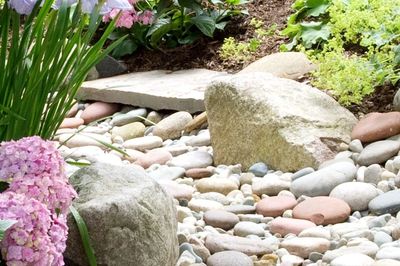
What Is Green Stormwater Infrastructure?
Every roof, driveway, parking lot and patio changes the way rainwater moves across a property.
Instead of allowing rainfall to rapidly run across hard surfaces and overwhelm low areas, storm drains or neighboring properties, green stormwater infrastructure uses the landscape itself to help manage that water.
Depending on the property, that might mean:
capturing rainwater in a rain barrel,
redirecting runoff into a rain garden,
filtering runoff through a bioswale,
creating a vegetated drainage corridor,
installing permeable pavement,
removing unnecessary pavement,
or combining several systems into one coordinated drainage plan.
The Northeast Ohio Regional Sewer District describes green infrastructure as stormwater source-control practices that can store, filter, infiltrate, harvest, reuse and evapotranspire stormwater, helping reduce stress on drainage infrastructure while providing environmental benefits.
That’s the philosophy behind our approach.

Residential Green Drainage Solutions
Your yard can do more than just look good.
A properly designed landscape can become part of your property’s stormwater-management system.
Rain Gardens
A rain garden is a planted depression designed to temporarily collect runoff from a roof, driveway or other hard surface.
Instead of immediately sending that water toward the street or storm sewer, the garden slows it down, spreads it out and allows the soil and plants to help manage it.
And it doesn’t have to look like a drainage structure.
We can design rain gardens with attractive Northeast Ohio-appropriate plantings, stone, natural contours and defined overflow paths so the finished feature becomes part of your landscape.
Rain gardens are recognized by local watershed organizations as a practical way to capture and filter runoff from rooftops and driveways.
Good for:
- Downspouts that currently discharge across the lawn
- Low areas that repeatedly collect runoff
- Large roof areas
- Properties looking for a natural drainage solution
- Homeowners interested in reducing runoff
- Landscapes where a traditional drain system isn’t the best answer

Rain Barrels & Rainwater Collection
Don’t send every drop of roof water away.
A rain barrel captures water directly from a downspout and stores it for later use.
That water can then be used for things like:
watering gardens
watering landscape plants
watering trees
and other appropriate outdoor uses.
For Northeast Ohio homeowners, this can also have a financial component.
If your property is within the Northeast Ohio Regional Sewer District’s service area, qualifying stormwater-control measures may be eligible for a stormwater fee credit. NEORSD specifically recognizes approved on-site stormwater storage such as rain barrels, cisterns and rain bladders. Requirements apply, so we help you understand the project requirements rather than promising a credit automatically.
We can help with:
Downspout-to-barrel connections
Rain barrel placement
Overflow management
Multiple-barrel systems
Rainwater storage planning
Integration with rain gardens or landscape drainage
Stormwater-credit considerations
For example, NEORSD’s current residential application requires at least 50% of the roof to drain into qualifying rain barrels for that particular credit application.
The goal isn’t simply to install a barrel. It’s to
design the entire water path around it.

Bioswales
A drainage channel that works like part of the landscape.
A bioswale is a gently graded, vegetated drainage feature designed to slow, convey and filter stormwater.
Instead of a traditional ditch cutting across your property, a properly designed bioswale can become an intentional landscape feature.
Water enters the swale, moves through a defined soil and vegetation system, and continues toward an appropriate outlet.
Bioswales can be particularly useful around:
commercial parking areas
office buildings
HOA properties
retail properties
large residential lots
driveways
roads and access areas
building downspouts
NEORSD materials describe bioswales as linear bioretention systems that can be used near roadways, parking areas and downstream of building downspouts.
The Treva approach
We don’t dig a ditch and call it a bioswale.
We evaluate:
existing elevations
runoff sources
available space
soil conditions
slope
overflow routes
planting areas
maintenance requirements
and the final discharge location.
The result is a drainage feature designed around the property.